
Global Credentials. Institutional Trust. Streamlined Compliance.
Cognicert unites internationally recognized professional certifications, independent management systems auditing, and advanced personnel qualification into a single unified platform. From structural risk mitigation to global standards implementation, we give professionals and enterprises the verified credibility needed to command authority in any market.

Cognicert at a glance
Featured Programmes

ISO 16091 Integrated Logistics Support (ILS) Lead Auditor Course
Course Overview The ISO 16091 Integrated Logistics Support (ILS) Lead Auditor Course is designed to equip participants with the knowledge and practical…
View ISO 16091 Integrated Logistics Support (ILS)…
ISO 37002 Whistleblowing Lead Auditor
The ISO 37002 Whistleblowing Lead Auditor Course equips participants with essential skills to audit whistleblowing management systems effectively.
View ISO 37002 Whistleblowing Lead Auditor
ISO 30409 Lead Auditor Course
The ISO 30409 Lead Auditor Course equips participants with the knowledge and skills required to plan, conduct, report, and follow up audits…
View ISO 30409 Lead Auditor Course
Become a Cognicert Trainer
Join Cognicert’s global network of expert trainers and help professionals build competence in ISO standards and quality management.
Read: Become a Cognicert Trainer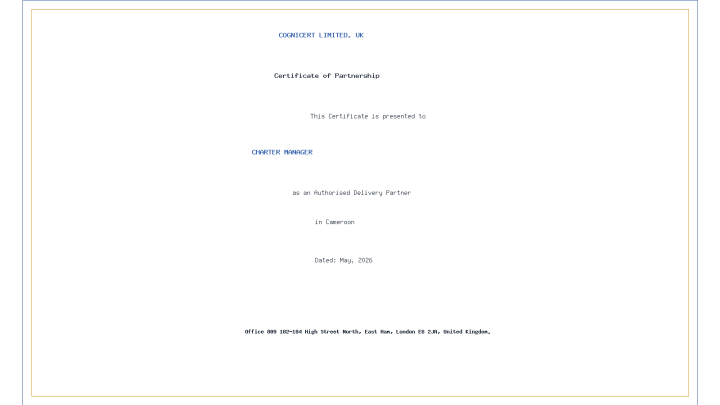
Cognicert Appoints Charter Manager as Authorised Delivery Partner in Cameroon
Cognicert is pleased to announce the appointment of Charter Manager as an Authorised Delivery Partner in Cameroon, enhancing training services.
Read: Cognicert Appoints Charter Manager as Authorised…
Cognicert has signed a partnership agreement with Chartered Managers Sarl, Cameroon
Cognicert has partnered with Chartered Managers Sarl in Cameroon to enhance management practices.
Read: Cognicert has signed a partnership agreement…Strategic Insights

The Hidden Risk of Poor Welding Coordination
The Hidden Risk of Poor Welding Coordination practical governance insight for leaders and managers.
Read: The Hidden Risk of Poor Welding…
ISO 14731 Welding Coordination: An Executive-Level Strategic and Operational Analysis for Optimal Governance and Risk Management
An authoritative deep-dive into ISO 14731 Welding Coordination—examining strategic, governance, operational, and risk perspectives. Insights on global trends, regulatory frameworks, implementation best…
Read: ISO 14731 Welding Coordination: An Executive-Level…
The Governance Problem Behind Failed Joint Ventures: An Executive-Level Deep Dive
An in-depth analytical exploration of the governance challenges driving joint venture failures, examining strategic, operational, risk, and performance dimensions with global data,…
Read: The Governance Problem Behind Failed Joint…Upcoming Events

Waste, Material & Carbon Management Strategies Webinar
In this webinar, you’ll learn how to: ✔️ Design out waste from your processes ✔️ Optimize material and resource efficiency ✔️ Reduce carbon footprint across operations ✔️ Build resilient and sustainable supply chains

Circular Economy Best Practices Training and UK Tour
Cognicert Limited is delighted to introduce an exceptional international training experience tailored for environmental and sustainability professionals across West Africa — the ISO 59004 Lead Assessor Train & Tour Bundle in the United Kingdom. This unique program blends globally recognized training and certification in ISO 59004 – Circular Economy Framework and Principles, with curated business tourism, industrial visits, and comprehensive logistics support, including visa facilitation. Participants enjoy a seamless, high-value professional development journey while gaining direct exposure to leading circular economy practices in the UK.

Attracting, Developing & Retaining High-Performance Talent in a Standards-Driven Economy

Managing Mining Legacies and Reclamation UK Study Tour and Training
Understanding what constitutes a “mining legacy”, risks & liabilities, regulatory & ESG drivers.

Cognicert Cyber Resilience Summit 2026

ISO 30414 Human Capital Reporting Lead Verifier Course

ISO 14064 Lead Verifier Course
What Our Clients Say
Google Reviews
See existing Google review performance for Cognicert and share your public review on Google.
Client Direct Feedback to Cognicert
Submit direct feedback about Cognicert training, certification, audits, or customer support. Approved feedback will be displayed on this website.
Ready to advance with Cognicert?
Partner with Cognicert to access world-class training, internationally relevant certification, and professional development solutions that strengthen capability, build credibility, and drive lasting organizational success.